
The Mother Is Angry
For generations the sea fed Podampeta, and its people called her mother. Now she eats the village street by street, and the elders say she has turned: she is Bhagwati, the angry goddess.
A week after I stood in a pink and blue house at the village's edge, she took that too.
My fifth jagah for Jagah, the climate storytelling and journalism project we run at FactorDaily with the Rainmatter Foundation, from a coast in Odisha where every village knows its place in the queue.
**
Last month I walked through a house at the edge of Podampeta, on the Ganjam coast of Odisha. Pink on the outside, a pale milky blue in the arched passage within. The floor was red oxide, swept clean by wind because there was no longer anyone to sweep it. Through the far doorway you could see scrub, and past the scrub, the sea. Someone had chosen that blue. Someone had mixed it, or paid a painter for it, and put it on the walls of a passage their family would cross a hundred times a day. The family was gone. The house stood on the exact line where the village now ends.
Earlier this week, Gauri Behera told me the house is gone. It fell into the sea. There was no storm. There will be no headline.
This is my fifth jagah in the Jagah Storytelling Fellowship, after Bikash’s eroding river world in Majuli, Vijay’s poisoned rivers in Meghalaya, Nagma’s Van Gujjar forest in Haridwar, and Prasoon’s Baiga world on the edge of Kanha. It taught me a new way to read a coast.
On this stretch of Ganjam shoreline, geography behaves like time. Podampeta is a place in a queue, and every village on this coast knows roughly where it stands in the line.
Podampeta had six or seven streets. It has one. Seventeen hundred people lived here, in three hundred and forty-five households. The beach where they held their dance performances is gone. Four or five temples are gone; the most recent, a small Sai temple, went into the water two or three weeks before I arrived, and Gauri pointed at a place in the waves where people used to fold their hands. She pointed at a low hill of sand and said it had been a street. On a surviving wall a painted shop sign still reads POPULAR at the top and, below it, DUKHI. Popular was the shop. Dukhi, which means sorrowful, was the name of the boy who ran it. The sea has left the sign standing.
Lalita, the second Jagah fellow on this coast, had used one word when she first described Podampeta to me: Hiroshima.
Drive fifteen minutes down the same shore and you reach villages where the fishing economy is still in full motion, boats leaving at one in the morning, women meeting them at dawn, dry fish laid out under the sun. Stand in Podampeta and you are standing in those villages’ future. Everyone here knows it. Gauri gives one village, Ajyabali, two or three years. The families of the village beside Podampeta are already asking where they will go.
In the cities, climate change is an agenda. A panel, a report, a conversation over coffee that ends when the coffee does. On this coast nobody says the words climate change. They say the sea has come. The young people of Podampeta told Gauri’s team what changed inside them. We used to sit by the water in the evenings, they said. Now we are afraid of it. We are afraid it will come into the house. That sentence is from children describing their nights, in the present tense.
The two women helping me learn to read this coast were both born somewhere else.
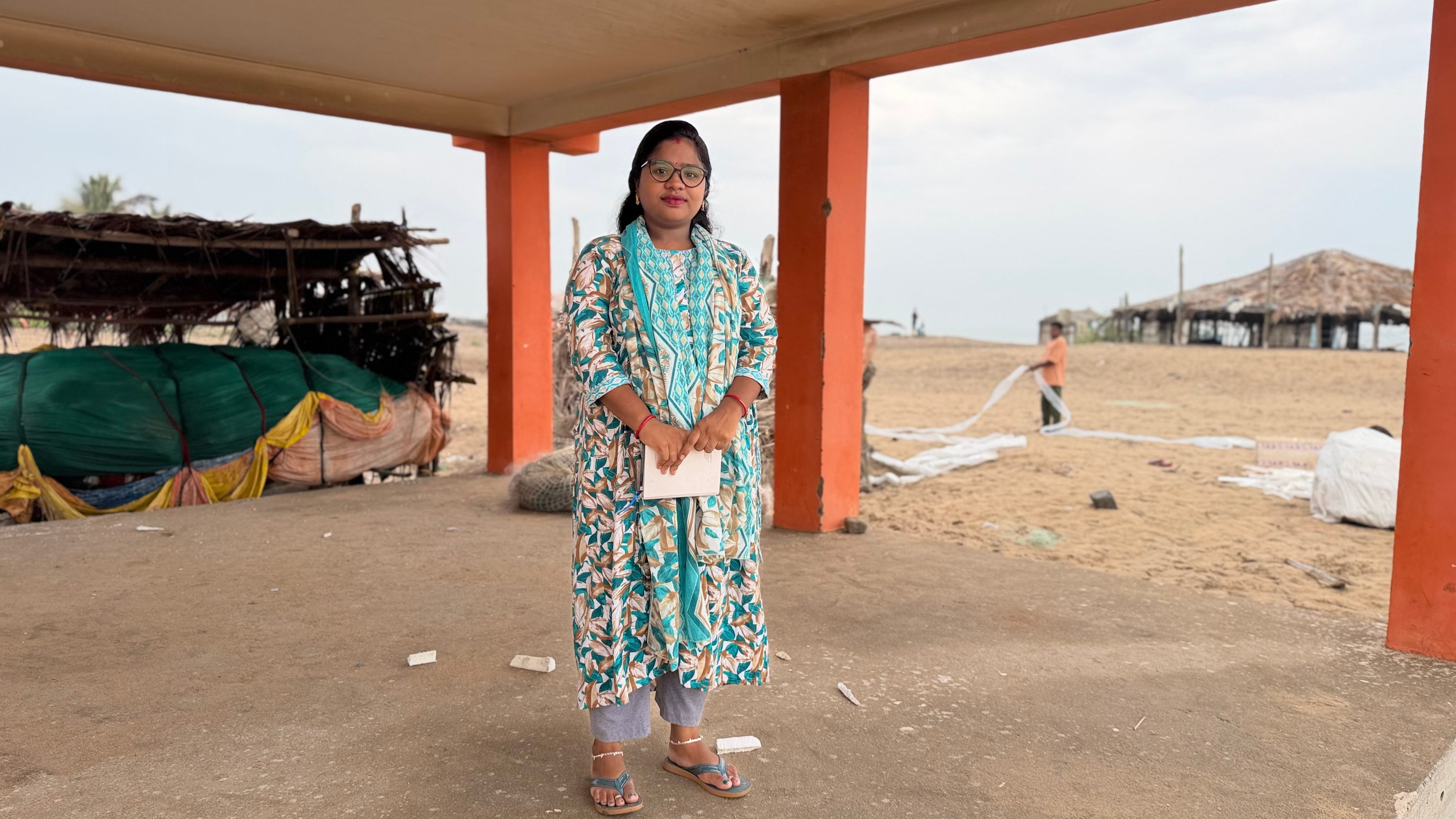
Lalita came to the fishing village of Sana Nolia Nuagaon as a bride, from a home ten kilometres inland where, she says, she was kept “in a box.” She and her mother would stand at the window and watch the street go by. She knew nothing of the sea. She learned it through her father-in-law, who left the house at midnight, at one, at two in the morning, and whose face at the door told the family everything before he spoke: on the days there was fish he came home khushi, happy, and on the days there was none he came home dukhi. She finished her graduation after marriage, then a B.Ed, joined the Dakshin Foundation, and turned the outsider’s position into the observer’s. The village that once saw only a daughter-in-law now talks to her like a sister.
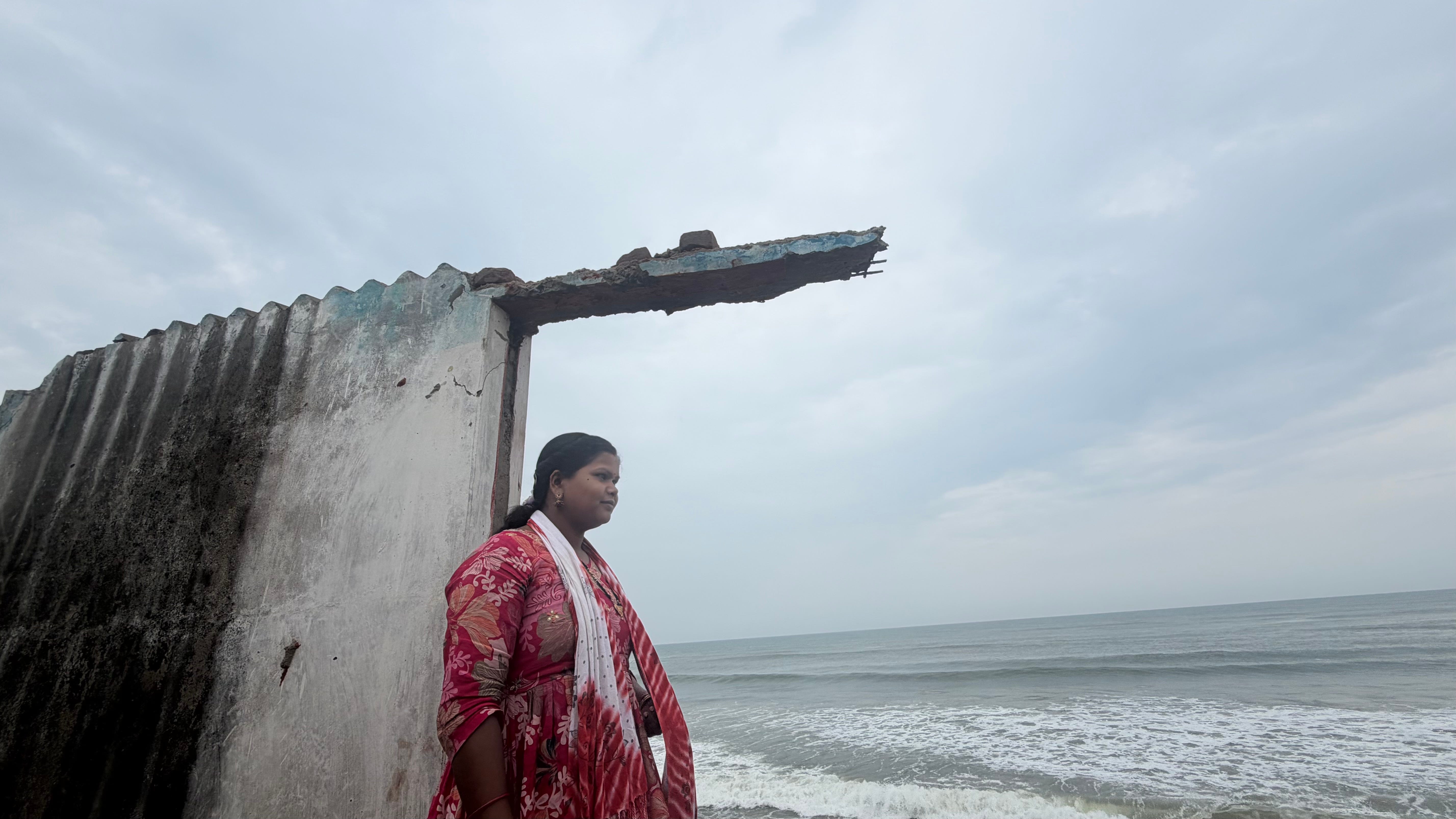
Gauri came to Purunabandha as a bride too, and began this work, she admits, for the income. The lockdown of 2020 changed why she does it. Men from these villages were stranded across the country and nobody could help them, because nobody had counted them. So Gauri went door to door and built the register that did: who has gone, to where, to which company, with whose phone number, who treats them when they fall ill. One family turned her away four or five times, suspicious of where the data would go, and she kept coming back until she could explain. Then the panchayat did something she had not asked for. It made her register permanent. Now anyone leaving the village records it at the office, Aadhaar in hand, and when men slip away without registering, it is their mothers and wives who come with the cards to enter them in the book.
The people losing the most on this coast own the least. They are Nolia, Telugu-speaking marine fishers whose families came north from the Andhra shore two, three, four generations ago and never acquired what the state recognises as arrival. They hold no land. The ground beneath their houses is government property. Ask the older ones their caste and many cannot say; the answer dissolved somewhere in the migration. What they have, Lalita told me, is the sea, and the world around the sea. That is the entire estate, and it is the estate the water is now repossessing.
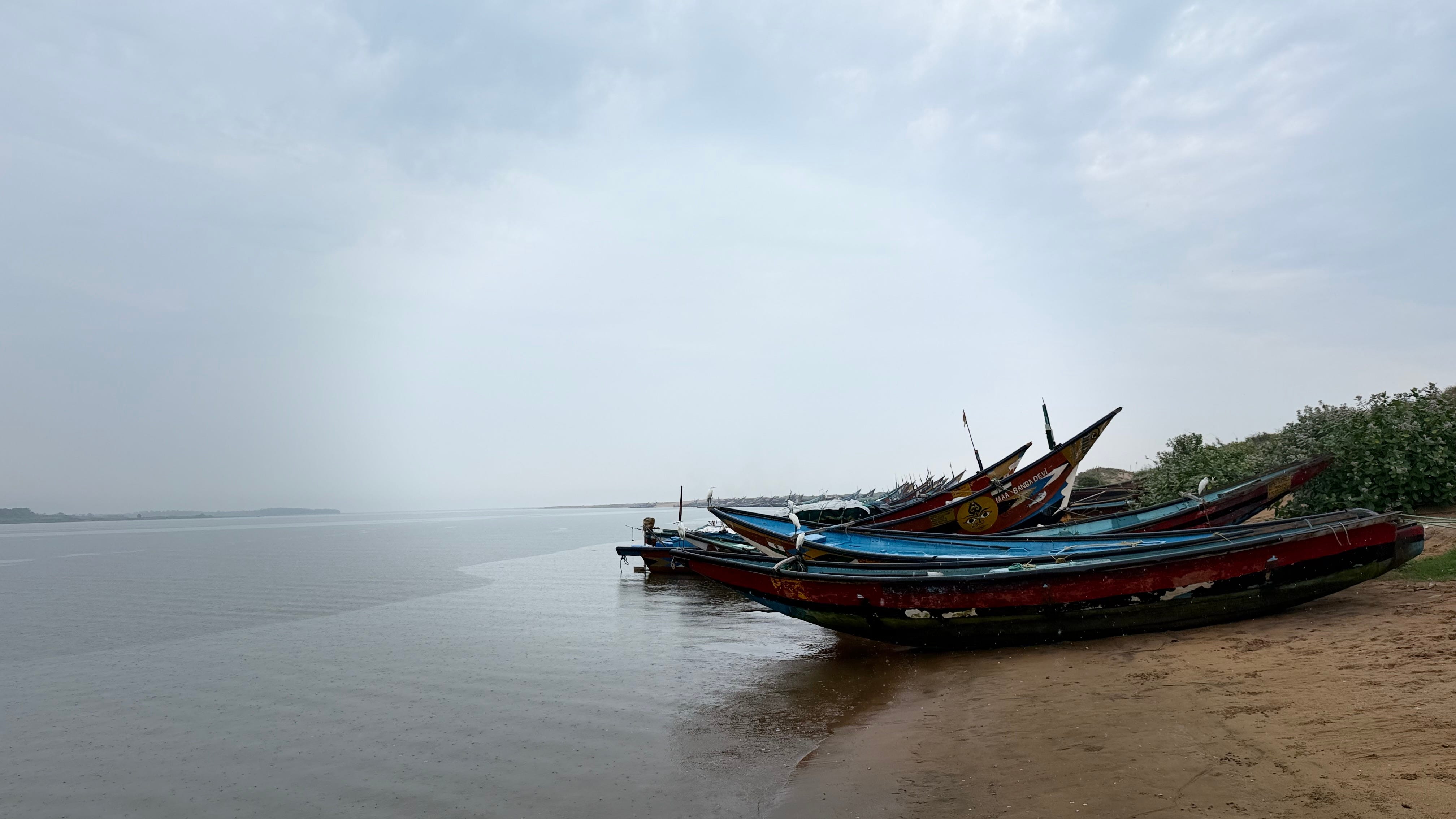
And when the water takes it, it takes more than houses. In the resettlement colony a few kilometres inland, Gauri says, the people of Podampeta feel like migrants in their own district, minutes from where they were born. The village’s festivals have stopped; the dispersal broke them. When former residents talk about the village, they cry, and Gauri told me plainly that when they cry, she wants to cry too. Her team began noticing what the community calls chit-chida, the irritability, and beneath it the sleeplessness: people lying awake thinking about the village, calling it worry because nobody has offered them another word. So last year they tried something small, in two villages. With the children it was a treasure hunt, objects hidden to match clues on slips of paper, and one of the objects was a temple bell. Why is the bell here, the team asked. The children built the answer themselves: when we feel bad we go to the temple, it is quiet there, we calm down. Gauri is honest about the limits. Her team has no clinical training; they were guided over WhatsApp; they have paused the sessions until they can be trained properly. That treasure hunt is, so far, the only mental health response this displaced coast has received. And the women of old Podampeta still return on festival days, to clean houses no one lives in.
Why is the sea doing this?
Podampeta holds three answers at once.
Gauri’s is the one she learned herself: the shore forests of casuarina and cashew and kewda were cut, and soil without roots leaves easily, and the villages have no garbage collection so everything goes into the sea and the sea rises to meet it. The elders’ answer is older than soil science. The sea, one woman of Podampeta says, was once calm and generous, was our mother, gave us fish. Now she is not our mother. She is Bhagwati. Ask why the goddess turned and she says she does not know; perhaps someone is angry with us. The third answer is the one that does not exist, because no long-term scientific study of this coast’s erosion has ever been completed. A coastline is disappearing faster than the science that would explain it, and in the gap a fishing people are left to choose between cut forests, drowned garbage, and an angry goddess.
The villages have stopped waiting.
For years, twenty-eight villages of this coast wrote to the government asking for a mini-harbour, somewhere to shelter their boats as the sea grew rougher. The letters went unanswered. One NGO wrote back that the community’s population was too small for its problems to be taken up. So seven villages pooled money from their own committees and built the harbour themselves. It has stood three years. The red-earth road to it was laid by the villagers too, no panchayat fund, nothing from the state, and for a while Lalita used to go running on it in the mornings. The trees along that stretch are theirs as well, government saplings planted by several villages together, roots set down to do what the bare shore of the drowned villages could not.
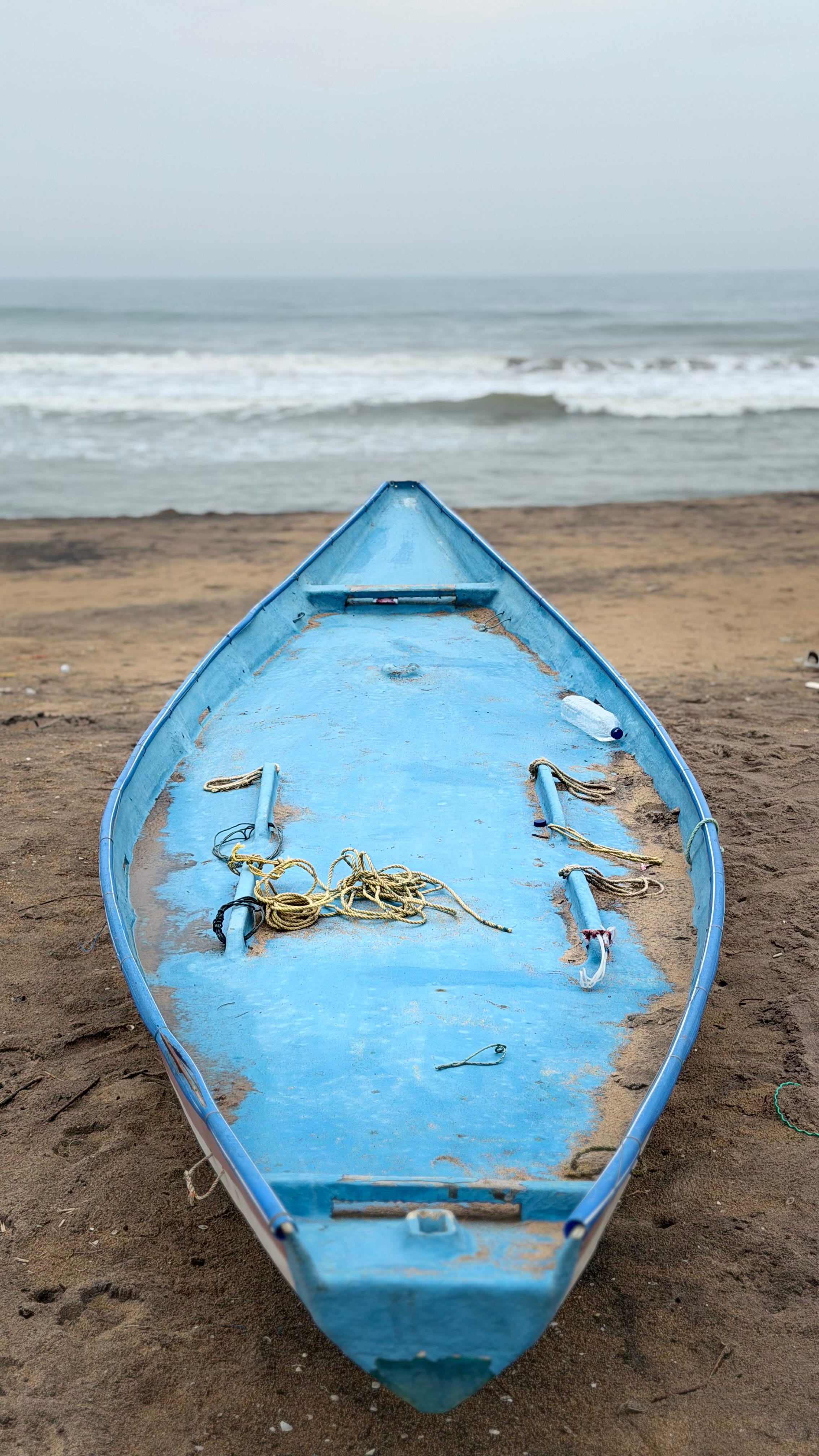
The women are taking back a trade. Sixty of them, across two villages, have formed producer groups to sell their dried fish directly, cutting out the middlemen at the big Humma market who buy cheap and let the quality die in a godown. Gauri’s team did the market research themselves, ten days of it, knocking on doors in inland towns to ask people what dry fish they eat and what they would pay for better. All sixty women now have bank accounts in their own names, so the money arrives where the work happened. Sixty women, sixty households, and their daughters can join after them. Lalita, on her side, has enrolled sixty school dropouts for their matriculation through distance education, walked villagers into gram sabha meetings they did not know they were allowed to attend, and reopened a village clinic that had been shut and forgotten until the community found it again during COVID.
None of this is on anybody’s front page. The queue keeps moving. Yesterday it moved by one blue house.
This is why Jagah exists.
In Nagma’s forest I learned that we miss climate stories because we have not learned to recognise care.
In Kanha I wrote a question in my notebook that I could not put down: how can you preserve nature without its people?
Podampeta asks the harder version. What happens to a people when their nature stops preserving them? On this coast the lesson came harder: what looks like custom is climate intelligence, and when a knowledge-bearing community is scattered, the coast loses its memory along with its people. Gauri and Lalita are the coast’s record-keepers. The only longitudinal study this shoreline has ever had sits in their notebooks and phone galleries, waiting for the researchers who have not yet come.
We run the Jagah Storytelling Fellowship at FactorDaily with the Rainmatter Foundation, whose backing lets this work travel slow and deep. Jagah is a long journey of listening before speaking, of letting a place speak in its own language. Some of our biggest climate stories are hiding in plain sight, in villages the world has already written off.
Podampeta is still on Google Maps. Five hundred families, at a set of coordinates that is now mostly surf. The map has not caught up. Neither, yet, have the rest of us.
Reported from the Ganjam coast, Odisha, with Jagah fellows Gauri Behera and A. Lalita, who work with the Dakshin Foundation.
Heartbreaking yet heartwarming as well.