
The Other Gardener
The best gardener on a Bangalore terrace is a squirrel. We leave them so little, and still they come to plant it.
I went to Sailee’s place in Bangalore one morning to talk about her work and her writing, and we did, for hours. But what I truly enjoyed was when her mother walked me around the terrace, plant by plant, telling me what she had grown. Halfway round she laughed and said the best gardener up there wasn’t her. It was a squirrel. Half of what is green on that roof was planted by an animal that has no idea it is planting anything.
The squirrel comes down headfirst. It is the only way she knows to come down anything. Her road in is the big tree that leans over the terrace wall, the one whose long green hangs down and spills toward the roof. She works out along the branches until they thin and bend under her weight, drops onto the top of the wall, and from the wall into the long planter, between two clumps of green, and she is already moving.
Three pale stripes run the length of her back. The old story is that the god-prince Ram, building his bridge of stone to Lanka to win back his stolen wife, was helped by a squirrel that carried sand to it a few grains at a time. He stroked the creature once in thanks, three fingers down its spine, and the marks have stayed on every palm squirrel since. This one has not heard the story. She would not sit still for it.
It is a soft Bangalore morning. The sun is just over the parapet, moving across the pots. Sailee’s mother had made us a cutting chai first, the Bombay kind, sweet and strong in a small glass with ginger and lemongrass cut through it; now she has me by the elbow, walking me through the terrace plant by plant.
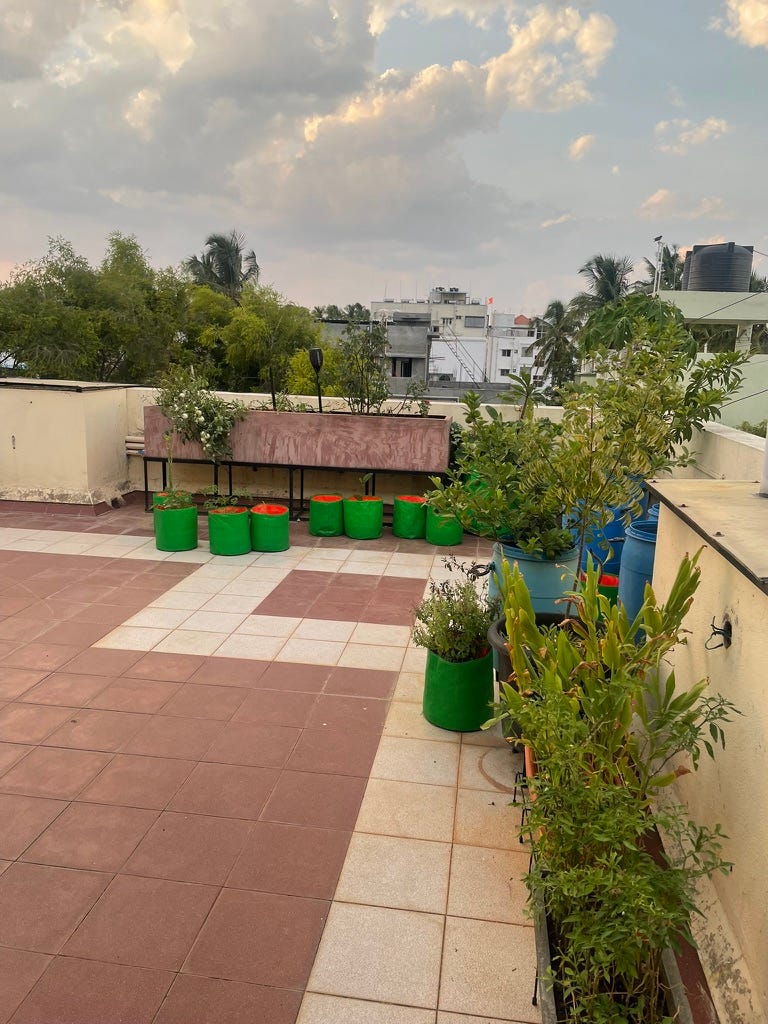
Most of it is her doing. She grew the guava the squirrel will not leave alone. She started the pineapple from a cut crown in a glass of water. There is mogra that keeps its sweetness for the evening, ajwain that stays on your fingers an hour after you touch it, a mango sapling she lets the caterpillars have, an avocado gone thin as a vine and propped on a stick against the wind. One plant by the rail she carried up from Lal Bagh, the old city garden, the week they first cleared this roof.
Sailee sits out here most days, chai going cold, a notebook open on her knee. The squirrel frightens her, she says, and means nothing by it. She bursts from a hole in the roof the moment you forget she lives in it, loud before she is anywhere, chit-chit-chit off the parapet, a brown streak over the pots and the hanging washing, one fast circuit, and gone. Some mornings she does not run. She stops on a branch and looks at you, gone completely still. Hard to believe a thing that restless can hold so still.
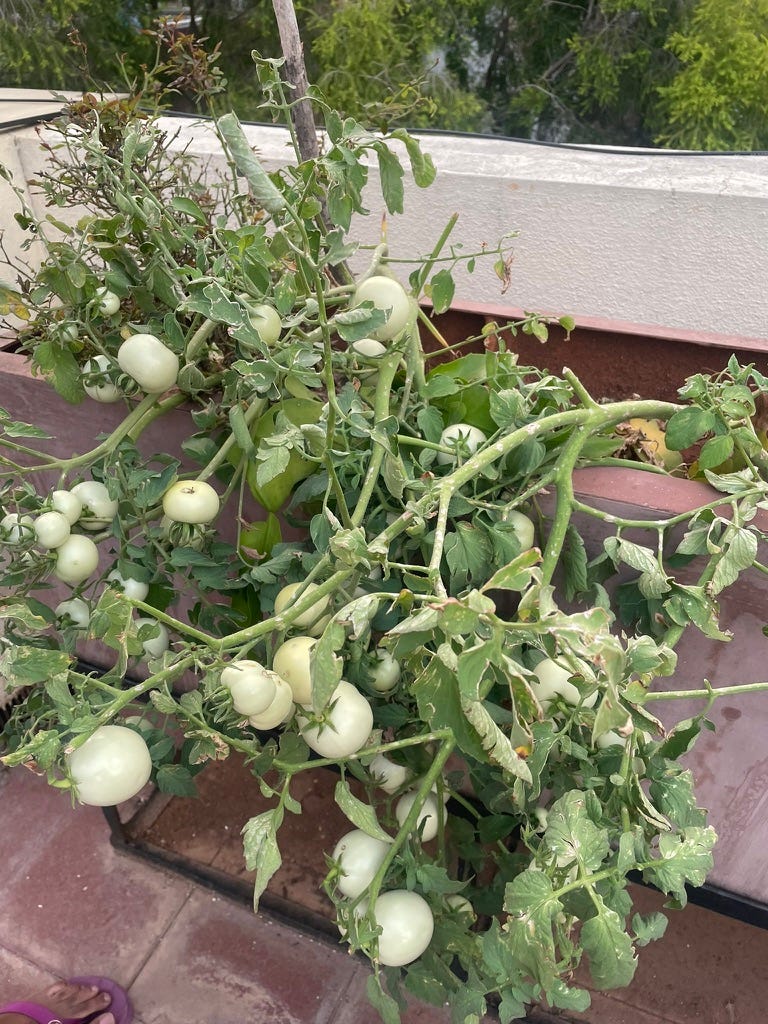
Half this garden is not theirs at all, Sailee’s mom says, laughing. Look at the tomatoes. The vine has thrown itself clear over the side of the planter and down onto the tiles, leggy and untidy, more stem than anyone staked for, and it is loaded. Dozens of them, smooth and swollen, the pale green of a fruit that has not yet been told it is nearly ripe. Nobody sowed a single one. The squirrel did. She carries a ripe tomato up to her tree, eats the wet middle, lets the rest drop, and the seed settles into whatever pot or crack it lands in and sees to itself. The papaya too. The mother gave up fighting it long ago; she lifts the strays into better soil and lets them be. None of this has reddened yet, which is the only reason it is still hanging there.
The squirrel does not know she is gardening. That is the best of it.
Sailee found a guava on the floor once, opened clean on one side. Clever animal, she thought, it tested the fruit first. Then she laughed at herself. The squirrel tested nothing. She smelled it ripe from the branch. Who eats a guava that isn’t ready.
On my way out Sailee showed me a small grey house under a ledge, chewed from paper by a wasp, the dimples of its making still in the walls. The wasp has gone. She was afraid of it once, she said, and then she wasn’t, and somewhere in between the wasp got used to her too. She calls it art. No one taught it that shape, and the next rain will take it off the wall.
From up in the tree where the squirrel sits, it is not a garden. It is breakfast and a dry hole to sleep in, with ground to cross between them. Nobody up there counts the tomatoes or asks what the morning was worth. She eats what is ripe, lets the rest fall, and goes back up into the leaves. By the time the green turns and she comes down for it, there will be more of it than before.
A squirrel I will never properly thank, and a million like her, still showing up to seed the world.
P.S. I have requested Sailee to share a picture of the squirrel the next time she spots her.
Heartwarming. So vivid is the description that I want to cuddle the squirrel